



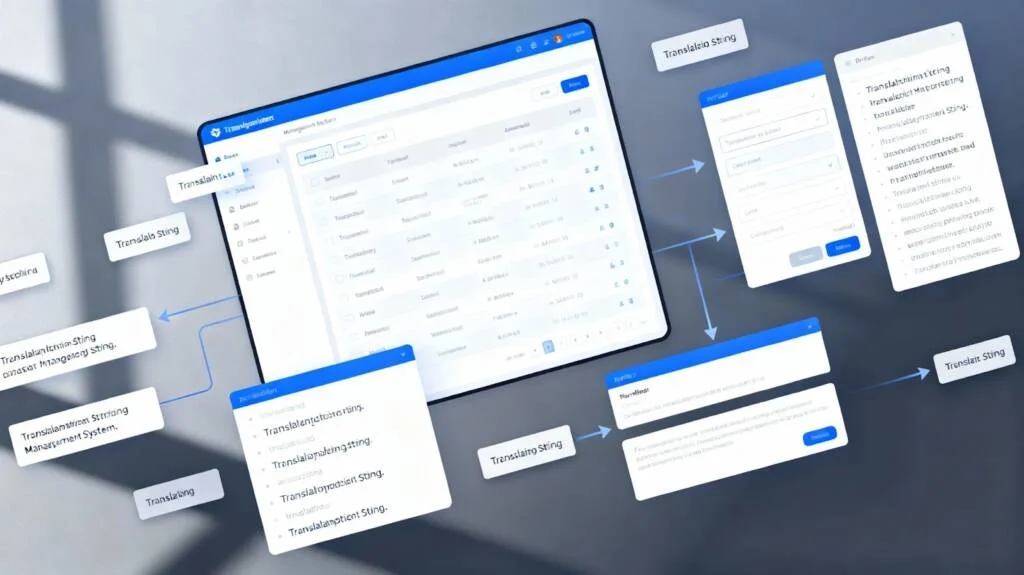
A translation management system sits at the heart of modern localization, helping companies scale multilingual content without losing quality or control. It centralizes people, processes, and language assets so teams can translate faster, cheaper, and more consistently across all markets.
Global digital landscape, businesses continuously publish product updates, marketing campaigns, and support content in multiple languages. To keep up with this pace, a translation management system becomes the backbone that orchestrates workflows, connects tools, and gives full visibility into every project stage.
What is Translation Management System (TMS)
A translation management system (TMS) is software that centralizes and automates the end‑to‑end translation and localization workflow across different teams, languages, and content types. In the second paragraph of this article, the term translation management system refers to this centralized platform that coordinates files, translators, reviewers, and language assets in one environment for maximum efficiency.
Unlike simple translation tools, a TMS acts as an operational hub: it handles project intake, assigns tasks, connects to content sources, and ensures that translation memories, terminology, and quality checks are consistently applied. It is designed not only for linguists, but also for product managers, marketers, engineers, and localization leads who must collaborate around multilingual content.
How it works
At a high level, a TMS connects your content sources (such as CMS, code repositories, design tools, or support platforms) and automatically pulls in new or updated text for translation. Once content arrives in the system, predefined workflows route it through steps like translation, review, proofreading, QA checks, and final approval, often without manual hand‑offs.
During translation, linguists work in an online editor that reuses existing translations through translation memory, surfaces preferred terminology, and can optionally pre‑fill segments using integrated machine translation. When all steps are complete, the TMS automatically pushes the localized content back to your original systems, ensuring that websites, apps, and documents stay in sync across languages with minimal manual file handling.
Benefits of a TMS
Using a translation management system delivers both operational and strategic benefits for organizations of all sizes. On a practical level, it reduces repetitive work, shortens turnaround times, and lowers costs by reusing existing translations and automating routine tasks like file preparation or status reporting.
Strategically, a TMS improves consistency and quality across markets by enforcing approved terminology, style, and brand voice, regardless of who performs the translation. It also provides analytics and reporting, allowing localization leaders to track volumes, costs, vendor performance, and quality trends, which supports data‑driven decisions about which markets and content types to prioritize.
How to choose a translation management system?
Choosing the right translation management system starts with clarifying your goals, content types, and existing tool stack. Begin by mapping where your source content lives (CMS, app repositories, design tools, help center, marketing automation, etc.), how frequently it changes, and who needs to participate in the translation process. This will help you identify integration requirements, workflow complexity, and user roles that your TMS must support.
Next, evaluate systems using a mix of functional and non‑functional criteria:
- Core features: translation memory, terminology management, online editor, workflow automation, built‑in QA checks, file format support.
- Integrations: native connectors or APIs for your CMS, repositories, design tools, support platforms, and CI/CD pipelines.
- Collaboration: role‑based access, comments, in‑context previews, support for internal teams and external vendors.
- Scalability and performance: ability to handle growing volumes, multiple products, and many language pairs.
- Security and compliance: data protection measures, access controls, certifications, and hosting options.
- Usability and onboarding: learning curve for translators, project managers, and technical teams, plus available training and support.
- Pricing model: per‑seat, per‑word, per‑project, or mixed; transparency and predictability of costs as you scale.
Running a pilot with real content, multiple languages, and a small group of translators and stakeholders is one of the most reliable ways to validate whether a TMS fits your workflows before a full rollout.
Top 5 translation management system including Crowdin.com
Below is an overview of five well‑known translation management systems, including Crowdin, that are widely used for software, website, and content localization.
| TMS | Main focus and strengths | Typical use cases |
| Crowdin | Cloud‑based localization platform with strong developer integrations, branching support, and powerful collaboration tools for distributed teams. | SaaS products, mobile apps, games, open‑source projects. |
| Phrase | Comprehensive localization suite with robust integrations, translation memory, and strong support for continuous localization pipelines. | Product localization, marketing content, websites, UI copy. |
| Lokalise | Developer‑friendly TMS with extensive API support, over‑the‑air updates for mobile, and automation for agile localization. | Mobile apps, web apps, fast‑release product cycles. |
| Smartling | Enterprise‑oriented platform with advanced workflow automation, quality measurement, and strong vendor management capabilities. | Large enterprises, multi‑vendor setups, high‑volume content. |
| memoQ server | Hybrid CAT/TMS solution with rich translation memory features and flexible project management for agencies and in‑house teams. | Translation agencies, corporate translation departments. |
Each of these systems offers translation memory, terminology management, collaboration features, and automation, but they differ in depth of integrations, pricing, and whether they lean more toward developer workflows, marketing localization, or translation agency models. Comparing them against your tech stack and organizational structure will help you determine which one provides the best balance of features, cost, and scalability.
Checklist for evaluating TMS pricing and ROI
A practical checklist for evaluating TMS pricing and ROI should focus on total cost of ownership, efficiency gains, and business impact. Use the points below as a yes/no or 1–5 rating list when comparing vendors.
Cost structure and licensing
- Identify pricing model (per user, per word, per project, MT usage, storage, connectors).
- Check minimum commitments, contract length, and volume tiers.
- Confirm what’s included: TM, glossaries, QA checks, MT, connectors, support, training.
- Look for hidden or add‑on costs: extra languages, SSO, custom workflows, premium support.
- Evaluate scalability of costs as languages, users, and content volume grow.
Implementation and integration effort
- Estimate setup time: configuration, integrations, migration of TM/terminology.
- Assess availability of native connectors for your CMS, repositories, design tools, help desk.
- Check API limits, automation capabilities, and need for custom dev work.
- Consider internal resource cost: PM time, engineering time, training effort.
Productivity and automation gains
- Measure expected reduction in manual tasks (file handling, copy‑paste, email coordination).
- Estimate time saved per release or per content batch.
- Verify strength of automation: workflows, auto‑assign, pre‑translation, QA checks.
- Assess ease of reuse via translation memory, term management, and content segmentation.
- Consider impact on release cycles (e.g., faster time‑to‑market for features/campaigns).
Quality and rework reduction
- Check how the TMS enforces terminology, style, and consistency.
- Evaluate built‑in QA (spellcheck, tags, numbers, terminology, placeholders).
- Estimate reduction in review cycles and change requests.
- Consider features for context (screenshots, in‑context preview) to reduce errors.
Collaboration and vendor management
- Assess how well the system supports internal teams, freelancers, and LSPs.
- Check role/permission granularity and ease of onboarding new users.
- Evaluate communication tools (comments, mentions, review flows, change history).
- Consider impact on vendor admin time: quoting, assigning, tracking, invoicing.
Reporting and ROI visibility
- Confirm availability of dashboards for volume, cost, turnaround times, and quality metrics.
- Check if you can track cost per language, product, or business unit.
- Assess ability to export data for financial and performance reporting.
- Define baseline KPIs (cost per word, cycle time, number of errors) and how the TMS will help improve them.
Risk, reliability, and support
- Verify uptime guarantees, SLAs, and incident response.
- Check security certifications, data residency options, and access controls.
- Evaluate support quality: response times, channels, coverage hours.
- Consider vendor stability, roadmap transparency, and pace of improvement.
Simple ROI framing
For each TMS, estimate annually:
- Total cost of ownership (licenses + implementation + internal time).
- Time saved (project management, translators, reviewers, engineers).
- Reduction in external spend from TM reuse and fewer reworks.
- Revenue or strategic upside from faster launches and more languages.
If the financial value of time saved and rework avoided clearly exceeds total cost of ownership within 12–24 months, that TMS’s pricing and ROI are likely favorable.
FAQs about translation management system
What is the difference between a TMS and CAT tools?
A TMS is a full workflow platform that manages projects, roles, content sources, and automation from start to finish, while CAT (computer‑assisted translation) tools are focused primarily on the translator’s workspace and linguistic features such as translation memory and terminology. Many modern TMS platforms embed CAT‑like editors so translators can work directly within the system without separate tools.
Do small teams really need a translation management system?
Even small teams benefit from a TMS once they handle more than a few languages or must update content frequently, because manual file exchange and spreadsheets quickly become error‑prone and slow. A lightweight, cloud‑based TMS helps centralize translations, maintain consistency, and avoid rework, often paying for itself in saved time and reduced duplication.
Can a TMS replace human translators?
No, a TMS is designed to support and augment human work, not replace it. While it can integrate machine translation to pre‑fill content and automate repetitive tasks, human linguists still provide the nuanced understanding, cultural adaptation, and final quality checks required for accurate and brand‑appropriate translations.
How long does it take to implement a TMS?
Implementation time depends on complexity: a simple setup with a few connectors and workflows might be operational within days, while large enterprises with multiple systems, custom workflows, and many stakeholders may need several weeks or months. Careful planning, phased rollout, and training help ensure that adoption is smooth and the organization captures full value from the platform.
