



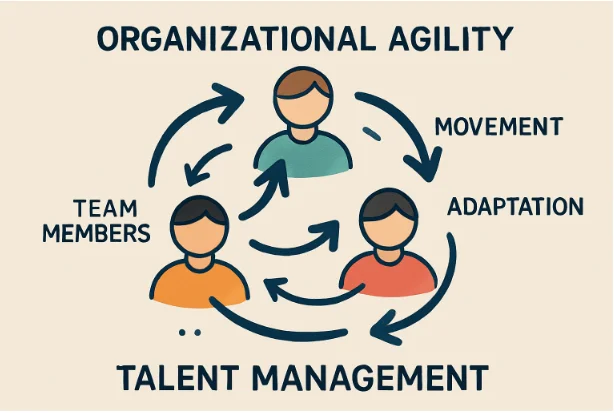
- Effective talent management enhances organizational agility, enabling swift adaptation to market changes.
- Implementing a structured talent management framework can significantly boost overall performance.
- Leveraging technology and fostering a culture of continuous learning are pivotal in modern talent strategies.
Contents
- 1 Introduction
- 2 Understanding Organizational Agility
- 3 The Role of Talent Management in Enhancing Agility
- 4 Key Components of Effective Talent Management
- 5 Leveraging Technology in Talent Management
- 6 Case Study: Successful Implementation of Talent Management Strategies
- 7 Challenges and Solutions in Talent Management
- 8 To overcome these barriers:
- 9 Final Thoughts
Introduction
Agility in business is no longer just an advantage; it is a necessity for sustainable growth. Organizations must navigate a landscape defined by rapid change, shifting consumer behavior, and technological disruption. To effectively respond to these dynamic pressures, businesses are increasingly turning to strategic talent management as a core enabler of agility. Consulting with expert partners, such as firms like Talogy, can help organizations embed agile principles into their talent strategies, ensuring their workforce is able to meet emerging demands and seize new opportunities.
Developing organizational agility involves more than restructuring business processes. It requires building a talent pool that is not only skilled but also open to continuous learning and rapid adaptation. A well-designed talent management framework aligns employees’ abilities with organizational goals, supporting resilience in the face of uncertainty and change.
Incorporating such frameworks is more than a short-term project. It is an ongoing journey that integrates recruitment, development, engagement, and technology, all aimed at cultivating adaptability across the organization.
As leaders consider how to future-proof their organizations, the importance of a robust talent management plan cannot be overstated. It is a foundational component for staying ahead of the competition and thriving in unpredictable markets.
Understanding Organizational Agility
Organizational agility is a company’s capacity to react promptly and effectively to shifts in the market, regulatory landscape, or industry trends. Achieving this state means not only having flexible processes but also fostering a culture where adaptability is embedded at every level. Agile organizations encourage cross-functional teamwork, rapid decision-making, and innovative problem-solving.
Employees are central to this process. Businesses that cultivate a workforce capable of responding to new challenges without hesitation will maintain a stronger competitive position. Research from the Harvard Business Review demonstrates that agile companies implement change more efficiently and report higher employee satisfaction, further amplifying positive business outcomes.
The Role of Talent Management in Enhancing Agility
Strategic talent management encompasses finding, developing, and deploying individuals in roles where they can create the most value. To enhance organizational agility, talent management must focus on:
- Building a Skilled Workforce: Cultivating robust in-house expertise as well as ensuring employees possess learning agility to adjust to new roles or requirements as they arise.
- Promoting Internal Mobility: Allowing talent to move freely within the organization to areas of greatest need, reducing time-to-productivity, and retaining institutional knowledge.
- Fostering a Culture of Continuous Learning: Providing ongoing training and growth opportunities, so employees remain engaged and up to date with industry or technological advancement.
Studies indicate organizations with a clear talent management strategy outperform rivals in both adaptability and financial performance. According to McLean & Company, structured frameworks make companies 1.5 times more likely to achieve high organizational performance.
Key Components of Effective Talent Management
For talent management strategies to drive agility, organizations should emphasize the following components:
- Comprehensive Talent Acquisition: Search for candidates who demonstrate adaptability, critical thinking, and resilience, ensuring recruits can thrive in fast-evolving roles.
- Continuous Development Programs: Create targeted initiatives to upskill and reskill employees, empowering them to respond to changing business priorities.
- Succession Planning: Identify high-potential employees and groom them for future leadership, ensuring continuity for critical business areas.
- Performance Management Systems: Align individual goals with organizational objectives and establish clear, transparent metrics to motivate high performance and accountability.
Leveraging Technology in Talent Management
Modern talent management is increasingly reliant on digital tools and data analytics. AI-powered platforms help human resources teams identify skills gaps, optimize recruitment, and forecast future talent needs. Digital learning solutions make ongoing employee development more accessible, while cloud-based performance management makes it easier to track and adjust goals in real time. According to McKinsey, organizations that revamp their people models with technology gain a measurable boost in value through increased organizational agility.
Case Study: Successful Implementation of Talent Management Strategies
One global technology company serves as a strong example of agility through talent management. Facing rapid market fluctuations and demand for new digital products, leadership launched an internal talent mobility program to reskill current employees for high-priority areas. Coupled with new digital learning platforms and transparent performance management, the organization quickly redeployed talent to where it was most needed. This approach resulted in decreased hiring costs, stronger retention, and an energized workforce.
Challenges and Solutions in Talent Management
As organizations evolve their talent management approaches, several key challenges may arise:
- Resistance to Change: Teams may be wary of new practices and reluctant to integrate new technology or processes.
- Identifying Future Skill Requirements: Predicting which skills will be most valuable is an ongoing puzzle, especially as new specialties emerge.
- Ensuring Leadership Buy-In: Without strong support from upper management, talent initiatives often fail to gain traction.
To overcome these barriers:
- Communicate the Benefits: Share clear evidence of how talent strategies drive agility, improve individual experiences, and strengthen the organization.
- Utilize Data Analytics: Use people analytics to guide hiring, development, and deployment, making decisions based on trends and metrics rather than guesswork.
- Engage Leadership Early: Bring leaders into the change management process from the outset to champion new approaches and model buy-in across the organization.
Final Thoughts
Building lasting organizational agility relies on continuous investment in talent. Strategic recruitment, learning, technology integration, and internal mobility collectively foster a resilient and future-ready workforce. By prioritizing these talent management principles, organizations not only elevate performance but are also better prepared to face whatever challenges the business world presents next.
