



Key Takeaways
- SD-WAN enhances network performance and reliability for businesses.
- It offers cost-effective solutions compared to traditional WAN architectures.
- Integration with cloud services and security frameworks, such as SASE, is seamless.
- SD-WAN adoption is growing across various industries due to its scalability and flexibility.
Introduction to SD-WAN
As digital transformation accelerates, businesses face heightened demands on their network infrastructure. The ability to reliably connect offices, applications, and users across diverse locations is now essential for operational agility and growth. Among modern solutions, SD-WAN managed services have quickly gained attention for their ability to optimize and secure wide area networks in ways that traditional WAN architectures cannot match.
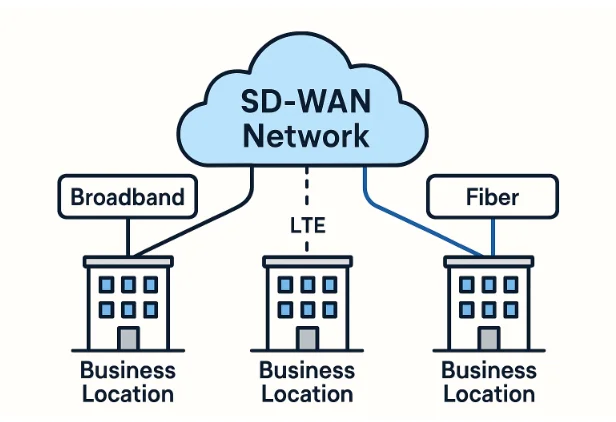
SD-WAN stands for Software-Defined Wide Area Network, and it revolutionizes how organizations manage connectivity by making it software-driven and application-aware. Rather than relying on rigid, costly MPLS circuits, SD-WAN enables businesses to leverage multiple connection types—such as broadband, LTE, or fiber—ensuring consistent performance and security even as usage patterns and network needs evolve.
The rise of cloud computing, remote work, and digital customer engagement is placing new strains on legacy networks. Companies need flexibility, speed, and security in their connectivity solutions more than ever before. SD-WAN fills this need with advanced capabilities that empower IT leaders to prioritize critical applications, rapidly adapt to network issues, and integrate directly with cloud resources.
As the adoption of SD-WAN grows, it is clear that software-defined networking is no longer a futuristic concept but a present-day essential for competitive enterprises. Gartner notes that SD-WAN is evolving fast across sectors, driven by both its cost-effectiveness and improved user experience.
Benefits of SD-WAN for Businesses
Improved Performance and Reliability
One of the most significant advantages of SD-WAN is its ability to route network traffic dynamically over the most efficient paths. By intelligently recognizing application requirements and network conditions, SD-WAN ensures that mission-critical applications receive priority, minimizing downtime and optimizing user experience. This kind of proactive management is vital in industries where consistent service delivery is non-negotiable, such as financial services and healthcare.
Cost Efficiency
Traditional WAN architectures often depend on high-cost MPLS lines, which can be prohibitive as businesses scale their operations. SD-WAN enables organizations to utilize lower-cost broadband connections, driving significant savings while maintaining, or even enhancing, performance. By reducing reliance on specialized hardware and enabling centralized management, SD-WAN also lowers operational expenses and gives IT teams greater flexibility to adapt their networks as business needs change.
Enhanced Security
Integrated security features are another cornerstone of modern SD-WAN solutions. With encryption, segmentation, and alignment with Secure Access Service Edge (SASE) frameworks, SD-WAN can protect data wherever it travels. This is especially crucial as organizations expand their use of cloud applications and remote access, increasing the potential attack surface and requiring vigilant policy management.
Scalability and Flexibility
As businesses grow, so do their connectivity requirements. SD-WAN supports rapid expansion by enabling centralized management and provisioning of new sites, applications, or users. This allows enterprises to quickly add or modify network resources, maintaining agility while controlling costs.
Integration with Cloud Services
Cloud adoption is a priority for organizations striving to modernize IT and deliver better services to customers and employees. SD-WAN is purpose-built for seamless cloud integration, providing direct, secure access to services like Microsoft Azure, AWS, and Google Cloud. By bypassing the data center bottleneck that often plagues legacy WAN architectures, SD-WAN reduces latency and improves performance for cloud-based applications, especially for real-time collaboration and data processing.
Streamlining cloud connectivity not only enhances user satisfaction but also supports business initiatives around agility, scalability, and cost control. According to Cisco, SD-WAN can reduce cloud application response times by up to 40 percent, thereby enabling more productive, responsive business operations.
Industry Adoption and Growth
SD-WAN is no longer a niche solution; adoption is accelerating across sectors as diverse as logistics, finance, retail, and healthcare. The global SD-WAN market is experiencing rapid growth, projected to reach over $21 billion by 2030. Key drivers include the quest for agile, cloud-ready networking, operational efficiency, and the flexibility to customize connectivity strategies. Industries with distributed branch offices and high regulatory requirements, such as banking and healthcare, are especially drawn to SD-WAN’s centralized security controls and simplified management.
Real-World Applications
Real-world deployments illustrate the business benefits of SD-WAN. DHL, for example, rolled out SD-WAN across thousands of global sites and saw a 35 percent reduction in application downtime while improving coordination between logistics centers. Similarly, multinational banks have adopted SD-WAN to enable secure, reliable connections between headquarters, branches, and cloud platforms, thereby protecting sensitive data while supporting a seamless customer experience. Research underscores how industries dependent on consistent uptime can rely on SD-WAN for cost-effective resilience.
Challenges and Considerations
As with any transformative technology, implementing SD-WAN is not without its hurdles. Deployment can be complex, especially for organizations with legacy infrastructure or limited in-house expertise. It is essential to develop a strategic plan that balances business priorities with technical requirements.
- Complexity in Deployment: Successful SD-WAN rollouts demand careful planning, expertise, and coordination between internal teams and technology partners.
- Security Concerns: Ensuring that your SD-WAN solution supports robust security policies, integrates with other defenses, and aligns with compliance standards is critical.
- Vendor Selection: With many SD-WAN providers on the market, organizations must carefully evaluate offerings to ensure compatibility with current networks and long-term business goals.
Future Outlook
The outlook for SD-WAN is bright, with ongoing innovation in areas like AI-driven analytics, zero-trust architecture, and tighter cloud integration. As businesses prioritize resilience and operational excellence, SD-WAN will play an increasingly central role in shaping software-defined enterprise connectivity.
Conclusion
SD-WAN is at the forefront of business networking transformation, delivering measurable benefits in performance, cost savings, agility, and security. For organizations determined to thrive in a rapidly changing digital landscape, embracing SD-WAN is now seen as both a foundation for growth and a source of competitive advantage. As the technology continues to mature, those adopting SD-WAN will be well positioned to meet the evolving demands of cloud-first, always-connected enterprises.
