



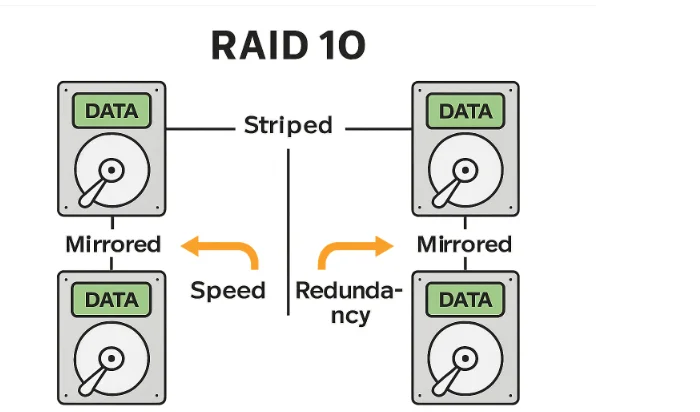
- RAID 10 combines mirroring and striping for superior speed and data protection, effectively reducing risks of data loss and slowdowns.
- It is ideal for environments where performance and uptime are crucial, such as those handling real-time customer transactions or big data analytics.
- RAID 10 enables quick recovery from drive failures, ensuring uninterrupted operation without extended downtime or complex restorations.
- Scalable and flexible, RAID 10 adapts to changing storage needs and can grow alongside your business.
- The configuration can be cost-effective when long-term reliability and reduced downtime are factored into the overall investment.
Modern businesses are under increasing pressure to safeguard their data while ensuring fast access and constant uptime. In this digital age, data is often the lifeblood of business operations, powering everything from daily transactions to long-term strategic planning. Maintaining data integrity and availability has become an essential goal for organizations in nearly every industry. One powerful solution that addresses these concerns is RAID 10, which combines the best features of RAID 1 (mirroring) and RAID 0 (striping) into a single setup. This hybrid approach provides both redundancy and performance, which many businesses find essential as they strive for both speed and security. This layered solution offers substantial RAID 10 redundancy and performance benefits, helping businesses maximize the value of their data infrastructure. Whether your business handles critical transactions, sensitive records, or large volumes of information, choosing a reliable configuration is more important than ever. By proactively adopting robust storage solutions such as RAID 10, companies can safeguard their reputations, ensure compliance, and maintain a competitive advantage.
Businesses that experience rapid growth or operate data-intensive systems must ensure their storage systems perform without interruption or data loss. As companies scale, the volume of information that must be stored, processed, and retrieved grows exponentially, increasing the risk of bottlenecks and downtime. RAID 10 excels in these scenarios by balancing performance and safety. Its architecture allows high-speed access and continuous operation even in the face of hardware failures. By understanding the multidimensional advantages of implementing RAID 10, organizations can build a resilient foundation for their digital assets and daily processes. This reliability enables IT teams to focus more on business innovation rather than spending excessive time reacting to crises or managing outages.
Contents
Enhanced Data Redundancy
Data redundancy is a cornerstone of business continuity, and RAID 10 delivers it through real-time mirroring. The setup duplicates data across pairs of disks, ensuring that if a single drive fails, an identical copy remains accessible. This dramatically reduces the risks of unexpected hardware failures, accidental deletions, or corruption, which are common concerns across sectors such as finance, healthcare, and e-commerce. Without built-in redundancy, organizations can be left scrambling during an outage, risking data loss and extended downtime. According to CSO Online, data breaches and losses can be extremely costly, making redundancy a vital investment for businesses of all sizes. With RAID 10, data remains safe and recoverable, so even catastrophic drive failures don’t become organizational disasters. This level of security is especially important as data privacy regulations tighten and consumers demand always-on reliability in the applications and services they trust.
Improved Performance
RAID 10 is engineered for speed thanks to data striping, which splits and writes data across multiple disks simultaneously. By spreading data across several drives, the load is balanced, allowing read and write operations to run simultaneously. This enhancement is essential for applications that are transaction-heavy or require rapid analytics, such as large-scale databases, financial trading systems, or virtualization hosts, where response time is directly tied to the user experience and business productivity. Improved input/output performance directly translates into higher productivity and shorter response times for end users, helping maintain a positive customer experience even during peak demand. Additionally, faster storage performance enables IT infrastructures to support more users and applications without degrading speed, making RAID 10 a future-ready solution as digital workloads continue to surge.
Minimal Downtime During Drive Failures
Downtime is costly and disruptive for any business, potentially resulting in lost revenue, damaged reputation, and lost customer trust. RAID 10’s design allows businesses to swap out failed drives on the fly (hot-swapping) without shutting down entire systems. This feature is crucial for businesses where system interruptions affect revenue or compliance, such as financial institutions, healthcare providers, and e-commerce platforms that must meet strict service-level agreements. The ability to maintain online operations while restoring full redundancy makes RAID 10 superior to simpler RAID setups like RAID 1 or RAID 0. In fact, CSO Online highlights the importance of uptime and business continuity planning as integral to meeting regulatory requirements and customer expectations. With RAID 10, teams can carry on mission-critical work with minimal disruption and panic, even if hardware fails unexpectedly.
Flexibility in Storage Capacity
RAID 10 is highly scalable and adaptable, making it a smart choice for businesses with evolving data needs. The technology allows organizations to increase or decrease capacity simply by adding or removing pairs of disks. This modular approach makes it easier to align infrastructure with current projects, seasonal demand fluctuations, or long-term expansion goals. For example, a retailer expecting a spike in online transactions during the holiday season can easily add storage to accommodate increased customer activity. This modular growth approach is particularly beneficial for organizations experiencing bursts of expansion, seasonal spikes, or ongoing digital transformation. Flexibility also means that resources can be optimized—organizations aren’t forced to overprovision just to ensure future viability. As requirements change, RAID 10 systems can be upgraded without expensive hardware overhauls or disruptive migrations, offering long-term value and peace of mind.
Cost-Effective Data Protection
Some may see RAID 10’s need for more drives as a drawback, but the investment pays off with long-term reliability and minimized risk. By using cost-effective, smaller drives in large quantities, businesses keep maintenance simple while benefiting from swift recovery after failures. Over time, this leads to a lower total cost of ownership than suffering major data incidents. The performance and protection afforded by RAID 10 often justify the initial hardware outlay, especially as data continues to grow in both volume and value. Avoiding just one major data loss event can save far more than the cost of implementing robust redundancy upfront. For organizations that prioritize both operational efficiency and risk management, RAID 10 remains a cost-effective and prudent option.
Final Thoughts
RAID 10 is not just a technical choice but a strategic business decision. By blending high-speed operations with uncompromising data protection, it supports critical applications and ensures ongoing availability for organizations that cannot afford to lose data or time. For businesses looking to future-proof their infrastructure and uphold the highest standards in data management, implementing RAID 10 is a smart, forward-thinking step. With the right combination of performance, scalability, and resilience, companies can focus on what truly matters: delivering exceptional value to their customers and stakeholders, no matter how complex the data landscape becomes.
