



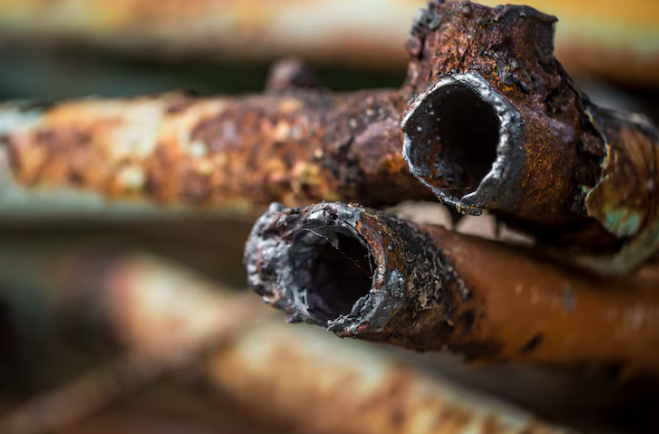
Dana closed on a 1912 four-square in Brookline last spring and spent her first Saturday admiring the oak trim. Three weeks later she was pricing plumbing repairs pittsburgh pa because the upstairs shower had faded from weak to barely there. The water also ran faintly orange for the first ten seconds. A plumber opened one section of wall and found the original galvanized supply line, scaled almost shut. That first repair was not the expensive part.
The expensive part is everything after it, and the point is worth stating outright. On a house with original supply lines, the real question is never what one leak costs. It is how many leaks you will buy before targeted replacement becomes the cheaper path. Most owners of century-old housing stock answer that one emergency at a time, which is the priciest way to answer it. Run the numbers once, early, and the choice stops feeling like a gamble.
Old Pipes Fail in Predictable Expensive Stages
Galvanized steel corrodes from the inside out, so the damage stays invisible until it changes how the house behaves. Pressure drops first, usually upstairs, because the interior diameter of a seventy-year-old line can shrink by half. Then comes the rusty tint on first draw, and then the pinholes, which tend to arrive in clusters. The case we see most often is an owner who has lived with weak pressure for two years and treats the first pinhole as bad luck. Luck has nothing to do with it. It is one pipe, one age, failing in the same order in every wall of the house.
What a Single Pinhole Leak Actually Costs
Ten years ago, finding a pinhole behind plaster meant opening the wall in two or three likely spots and guessing between them. Today the same call usually starts with an acoustic listening disc and a thermal camera. The opening is a square foot instead of six. That shift moved real money out of demolition and into diagnostics, so a leak-detection line on the estimate is a good sign rather than an upsell.
Say the first pinhole surfaces behind the kitchen wall. Diagnostics and the repair run $420, the drywall patch and paint add $180, so call it $600. Six months on, a second leak opens in the basement ceiling where access is easy, and that one lands at $330. The third hides behind bathroom tile, at $1,210 for the pipe work plus $540 to reset tile and grout. Nobody budgets for the tile guy (and yet there he is, on the invoice). Three leaks in under two years comes to $2,680, and the remaining eighty feet of galvanized in that house did not get any younger.
Spot Repair Versus Whole House Repipe Math

Two numbers settle this, and neither one is emotional: what the next repair costs, and how many more the house still has in it. A March 2026 peer-reviewed review of water-network monitoring counted about 260,000 water main breaks a year in the United States, running roughly $2.6 billion annually. That is what aging metal pipe does at municipal scale, on nobody’s schedule but its own. Inside one house the same chemistry plays out over eighty feet instead of eight miles. Once three or four repairs sit behind you, the running total has already climbed into repipe territory. Every dollar past that point buys more of the same tired pipe.
The arithmetic here is unsentimental about loyalty to old pipe. Somewhere around the fourth leak, patching stops being the frugal choice and quietly becomes the expensive one.
Water Damage Is the Hidden Line Item
Repair estimates cover the pipe and the labor to reach it. They rarely cover what the water did on the way down. In a four-square with plaster walls and original oak floors, that is where the real money hides. A pinhole above a first-floor ceiling can soak joist bays for weeks before any stain shows. By then you are paying for drying equipment, plaster work, and sometimes flooring. If water is running near a ceiling fixture or the electrical panel, shut off the main, cut power to that circuit, and call an electrician. Standing water and live wiring is never a wait-and-see situation.
How Financing Reshapes the Repair Timeline
Cost is only half of the decision on an old house. Timing is the other half, and financing usually decides which half wins. Contracting Business, reporting a Housecall Pro survey of homeowners, found that over half expect to spend more than $3,000 on repairs while a third expect more than $7,500. The same survey put 72% of owners in the camp that would pay a premium to have an emergency fixed within 24 hours. That last figure is the one to read twice, because it puts a price on panic. A 0% financing offer on a planned repipe, scheduled in a quiet month, beats the premium you will pay at 11pm on a holiday weekend. Emergency work is billed by the hour and by the panic.
Deciding When Patching Stops Paying Off
The line is easier to spot than most owners expect. If the house still runs on original galvanized and you have already paid for two leaks, the pattern is set. Upstairs pressure that never recovered is the third confirmation. At that point you are not maintaining a system, you are subsidizing one. Ask for a written scope that separates detection, repair, and replacement, so you can see which dollars buy a fix and which only buy time. Any company doing plumbing repairs pittsburgh pa homeowners recommend should hand you that comparison before a wall gets opened, with a per-fixture number you can check against another bid. Then the call is yours, made on paper in a calm week, instead of at 2am with a bucket.
