



Bay floors get treated as the last line item in a shop remodel, and that gets the priority backwards. Oil, brake cleaner, and spilled solvent never touch the lift or the compressor. They soak straight into bare concrete until it stains dark, dusts up, and turns slick under a boot. About the time a customer notices, a three-bay owner starts calling around for epoxy floor coating Minneapolis MN crews advertise as a one-day fix. Then the bids land, $4,100 from one outfit and $9,300 from another for the same 1,700 square feet. What separates those numbers is not gallons of shiny resin, it is surface preparation and the right resin chemistry for whatever hits the floor.
The Cheapest Epoxy Bid Usually Costs The Most
The low bid is low for reasons you can predict. It buys a thin water-based coat rolled over a slab that was acid etched instead of ground, and it skips the moisture test. Material is not where a contractor finds that kind of savings either. A May 2026 analysis from Grand View Research valued the American flooring market at $35.80 billion in 2025, projecting $68.07 billion by 2035 at a 6.7% compound annual rate. Nobody is dumping quality resin cheap to win a small garage job. The savings come out of labor hours, and labor hours are prep.
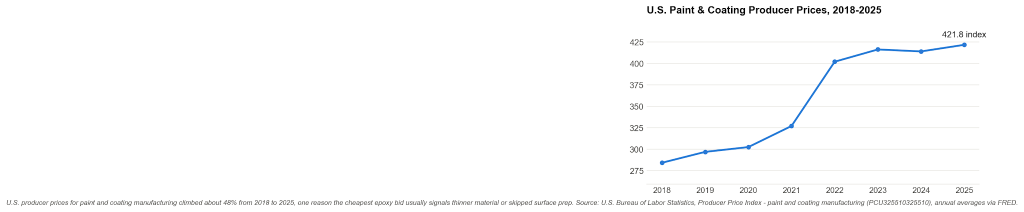
Price a real system at roughly $4 a square foot for a working bay. Honestly, closer to $4.50 once crack repair, a moisture test, and a non-slip broadcast land on the invoice. On 1,700 square feet that is about $7,650, which keeps a three-bay redo under the $8,000 most owners have in their heads. The $4,100 bid is not a better deal. It is a partial job with a repaint scheduled two winters out. Ask each bidder to itemize prep separately from material, and the gap between two numbers stops being a mystery.
Match The Coating System To Solvent Exposure
Not every epoxy is built for the same abuse. A parking deck sees tires and road salt, while a repair bay sees brake cleaner, transmission fluid, battery acid, and whatever drips off a fleet truck in February. The epoxy floor coating Minneapolis MN shops still like ten years later gets specified around that spill list. Usually that means a 100% solids epoxy base under a urethane or polyaspartic topcoat. The failure we run into most often is a thin water-based product sold as commercial grade, which softens wherever solvent sits.
Ask what the system is rated to resist, not how thick it goes on. A good estimator will name chemicals, give you a rough dwell time for a spill left overnight, and say plainly where the coating gives up. Slip resistance belongs in that same conversation, because a sealed floor with nothing broadcast into it turns treacherous the minute a tech tracks in snowmelt. Aluminum oxide or a fine quartz broadcast solves it for a few cents a square foot. Temperature matters too, because epoxy cures slowly once a bay drops below 60 degrees and a rushed winter install can stay soft for weeks.
Questions That Reveal A Crew’s Prep Standards
Concrete does not forgive skipped prep.
Diamond grinding is the standard, and a crew should tell you what profile they are opening the slab to before they quote. Acid etching is faster and cheaper, and it is the most common reason a coating peels off in sheets a year later. Moisture matters just as much, since a slab poured on wet clay with no vapor barrier pushes vapor up through the film until it blisters. A calcium chloride or relative humidity probe test costs almost nothing next to a redo.
- How will you profile the slab, and what profile number are you opening it to? A good answer names diamond grinding and a number, never acid etching.
- What moisture test do you run before priming, and what reading makes you stop? Look for a calcium chloride or RH probe result plus a walk-away threshold.
- Which chemicals is this system rated to resist, and for how long a dwell? Named chemicals and a timeframe beat a confident ‘everything’.
- Does the warranty cover the labor to grind and recoat if it delaminates? Material-only coverage is close to worthless on a bay floor.
Grinding also throws dust, so ask how the grinders are shrouded and vacuumed. A 2025 review in the Journal of Occupational Medicine and Toxicology reported that engineered stone runs over 90% crystalline silica by weight, against roughly 40 to 50 percent for granite. That is a useful measure of how much silica gets thrown loose whenever silica-bearing material is ground. Concrete carries crystalline silica too, and dust off an unshrouded grinder settles on every toolbox in the building. HEPA-filtered extraction on the machine is the sign of a crew that has done this work indoors.
Fumes are the other half of it. Solvent-based primers and topcoats release VOCs that build up fast in a closed bay, so the space needs mechanical ventilation, ignition sources shut down, and respirators on the crew. Any work that drops into a pit follows confined-space procedure. Overhead work carries its own rule, and OSHA requires fall protection in general industry on any walking-working surface with an unprotected side or edge 4 feet or more above the level below. Minnesota’s Department of Labor and Industry runs a free contractor license lookup, and two minutes there tells you whether the outfit bidding your bays is registered.
Choosing A Floor That Outlasts The Next Oil Change
Pick the crew on their answers about prep, moisture, and chemical exposure, then let price sort itself out. A bay floor that was ground properly, primed, and topcoated for solvent gets mopped instead of scrubbed. It throws light back into a dim shop and stops being the thing you apologize for when a customer walks past the open door. Eight to twelve years is a fair expectation in a working bay, longer where the drains slope right and the installer came back to check the cure. The cheapest bid buys a floor. The right questions buy the next decade of it.
